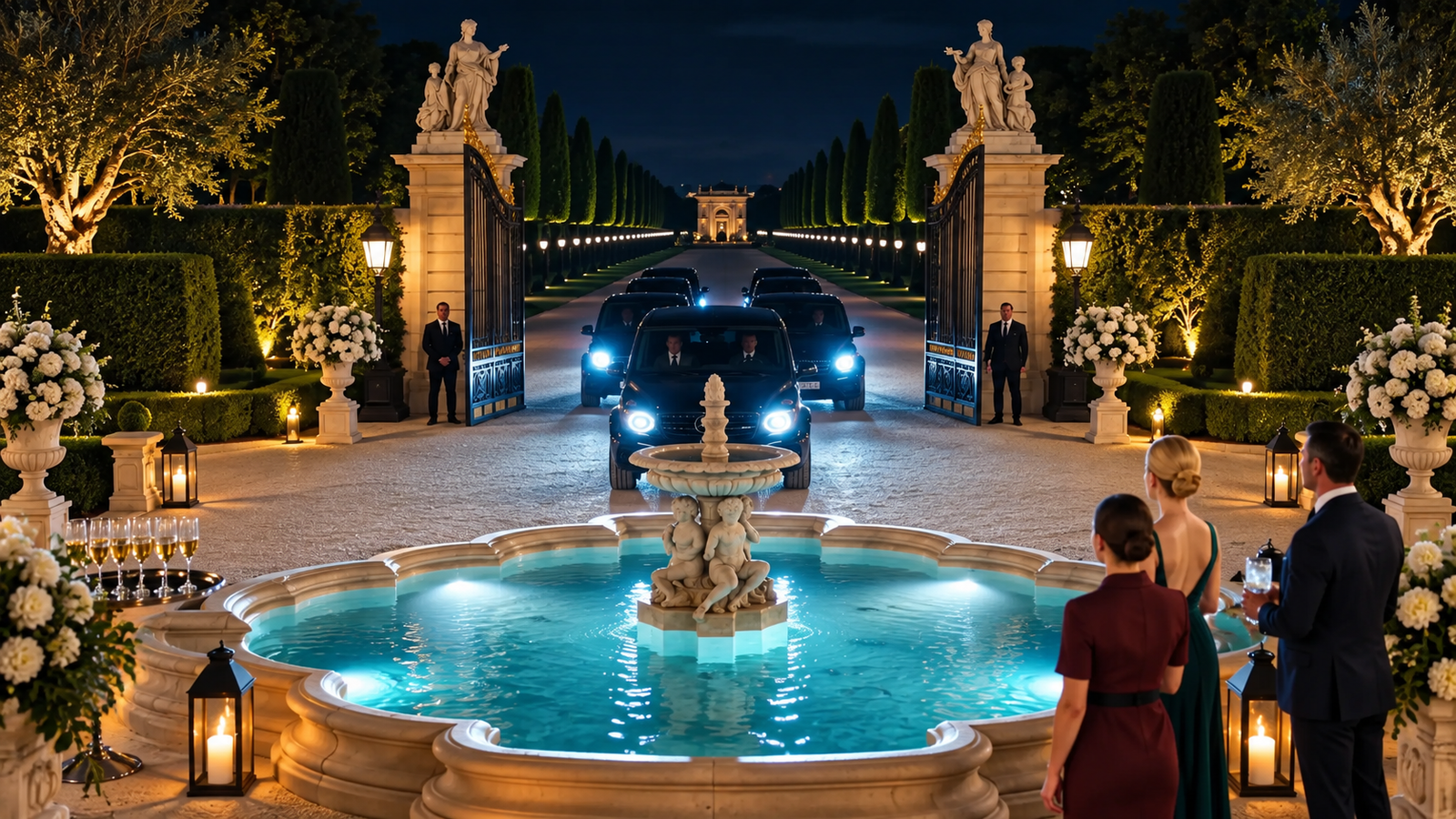
THE GIRL THEY PUSHED INTO THE FOUNTAIN
PART 1 — THE FALL
The blow did not come from a hand.
It came from a shoulder.
Camille Laurent barely had time to see Victoire Delacroix shift one step to the side, just enough to block her path at the edge of the fountain.
The impact was sharp.
Her silver tray tipped.
The champagne flutes flew through the air like shards of crystal suspended for a fraction of a second.
Then everything shattered.
Camille lost her balance.
Her heel slipped on the damp stone.
And she fell straight into the fountain.
The icy water swallowed her beneath the gaze of nearly two hundred guests.
A brief cry swept through the courtyard of the private mansion.
Then silence.
And finally, laughter.
Juliette Moreau's laughter.
Camille slowly rose back to the surface.
Water streamed down her face.
Her burgundy dress, immaculate only seconds earlier, now clung to her skin.
Around her, beneath the golden garden lights, the guests stared.
Some with embarrassment.
Others with curiosity.
A few with that particular expression Camille knew all too well.
Relief that they were not in her place.
Victoire leaned slightly toward her.
Her emerald-green dress caught the light from the lanterns.
She wore that precise, controlled, almost elegant smile that made her cruelty feel even colder.
"At least now she's clean."
Juliette burst out laughing.
Two men near a table looked away.
An elderly woman frowned.
But no one moved.
Camille remained still in the water for a few seconds.
She could hear her own breathing.
The water lapping against the stone.
The whispers.
And behind all of it, a sentence that had stayed with her since childhood.
"Never answer when they want to see you lose control."
Her father had taught her that.
She had been eleven at the time.
She had not understood.
That night, she understood perfectly.
Camille placed both hands on the edge of the fountain and pulled herself up.
She climbed out without asking for help.
Her shoes made wet sounds against the ground.
Juliette covered her mouth with one hand, still amused.
Victoire folded her arms.
"Perhaps you should go home, miss."
Camille did not answer.
She slowly picked up the tray that had fallen to the ground.
She placed it on an empty table.
Around her, the reception had stopped functioning normally.
No one was speaking the way they had before.
Everyone was waiting.
They wanted to see whether the young employee would cry.
Scream.
Beg.
Call her supervisor.
Camille did exactly the opposite.
She turned toward Victoire.
Her face revealed almost nothing.
"Enjoy the evening."
Victoire raised an eyebrow.
"Why? Are you leaving?"
Camille held her gaze.
"No. You are."
This time, no one laughed.
The silence changed.
Juliette looked at Victoire.
Then at Camille.
"Excuse me?"
Camille slipped a hand into the inside pocket of her uniform.
Victoire gave a nervous smile.
"Who are you going to call? Your supervisor?"
Camille pulled out a black phone.
She dialed a number.
One ring.
Someone answered.
Camille never took her eyes off Victoire.
"Let them in."
She hung up.
A few yards away, one of the event directors, Arnaud Mercier, immediately stopped smiling.
His colleague, Philippe Vasseur, turned toward him.
"What's wrong?"
Arnaud was already looking toward the gates.
"Nothing."
But his face said otherwise.
Victoire noticed the exchange.
"Do you know that girl?"
Arnaud did not answer.
At that same moment, headlights appeared in the street.
First two.
Then four.
Then ten.
The tall gate of the private mansion began to open.
The conversations froze.
A black sedan slowly entered.
Then a second.
Then an SUV.
Then another.
Six black vehicles in all glided into the courtyard with almost silent precision.
No sirens.
No logos.
No visible chauffeurs.
They stopped in a semicircle.
The engines remained running.
No one got out.
The doors did not open.
The windows remained black.
And for the first time since the evening began, Victoire stopped smiling completely.
"What is this?"
Camille watched the cars.
Arnaud had gone pale.
Juliette stepped back slightly.
A waiter nearly dropped a glass.
Victoire turned sharply toward Camille.
"Who are you?"
Camille did not answer.
She simply picked up a napkin from a table and slowly wiped the water from her face.
Then she looked at Victoire.
"You wanted everyone to see who I really was."
She paused.
"Maybe you should have been more careful."
The door of the first car remained closed.
But inside, a light had just switched on.
And Arnaud understood before anyone else that this was no longer a charity gala.
It had become a reckoning.
PART 2 — WHAT NO ONE KNEW
An hour earlier, no one had paid any attention to Camille Laurent.
She had arrived through the service entrance at 6:10 p.m.
No chauffeur.
No designer dress.
No flashy jewelry.
Only her burgundy uniform and a discreet black bag.
She had signed the staff sheet like everyone else.
"Camille Laurent — reception staff."
Nora, a student working as a server that night, had smiled at her.
"First time here?"
Camille hesitated for a second.
"Not exactly."
"You know the place?"
Camille looked around.
The pale stone walls.
The grand interior staircase.
The small balcony overlooking the garden.
"A little."
Nora did not press her.
She had no idea that Camille had spent part of her childhood in that house.
Before the galas.
Before the investors.
Before the reception rooms were rented out for private evenings costing tens of thousands of euros.
Back then, the mansion belonged to her grandfather, Étienne Laurent.
A discreet man, almost invisible in business magazines, yet known by every major French hotel group.
Étienne had built his fortune without ever developing a taste for luxury.
He always said:
"A beautiful place has no value if the people who work there are treated like furniture."
Camille had grown up with that sentence.
Then her father, Marc Laurent, had taken over part of the family business.
Unlike Étienne, Marc had been forced to deal with a new generation of investors.
More aggressive.
More media-savvy.
More obsessed with appearances.
Among them was the Delacroix Patrimoine Group.
Victoire's father, Henri Delacroix, had held a significant stake for five years in the company responsible for operating the mansion.
Henri was not the owner.
But he liked to let people think he was.
His daughter even more so.
In Victoire's world, owning fifteen percent was enough to speak as though you owned one hundred.
Camille, meanwhile, had never tried to appear in the press.
After studying hotel management in Lausanne, she had refused an immediate executive position.
She wanted to understand how the family business really worked.
Not how it looked in financial reports.
How the kitchens worked.
The locker rooms.
The night teams.
The housekeepers.
The servers.
The cleaning staff.
For a year, she had worked under her own name, but without any special title, at different properties owned by the group.
In Lyon.
In Bordeaux.
In Nice.
Then in Paris.
Most employees had absolutely no idea who she was.
Only a few senior executives knew.
Arnaud Mercier was one of them.
That was why, when the black cars entered the courtyard, he immediately understood that something serious had happened.
A few days earlier, Marc Laurent had sent him a very clear message.
"Camille will be present at the gala. She wants to observe how the evening operates as a member of staff. No special treatment."
Arnaud had obeyed.
But he had never imagined that someone would push Camille into a fountain.
Least of all Victoire Delacroix.
"Arnaud."
Victoire's voice snapped him back to reality.
She had walked over to him.
"You're going to tell me what's happening."
"Madame Delacroix..."
"Are those cars yours?"
"No."
"The organizers'?"
"No."
Juliette, now far less amused, looked at the vehicles.
"Maybe it's a VIP arrival?"
Arnaud stared at Camille.
"Possibly."
Victoire followed his gaze.
"Her?"
Arnaud still did not answer.
Camille had walked toward a small service room beside the courtyard.
Nora followed her.
"Camille!"
Camille turned around.
"Are you okay?"
"Yes."
"No, you're not. She pushed you on purpose."
Camille gave a faint smile.
"I know."
"Why aren't you saying anything?"
"Because there are times when speaking too soon gives the wrong people an advantage."
Nora stared at her.
"Who are you?"
Camille took a dry jacket from a locker.
"Someone who wanted to know how people behave when they think no one important is watching."
Nora fell silent.
Camille added:
"And tonight, I got my answer."
Outside, the atmosphere had grown heavy.
The guests kept watching the cars.
An elderly man approached one of them.
Arnaud stopped him.
"Sir, I advise you to stay back."
"Why?"
"Because I still don't know who's going to get out."
The remark spread quickly.
Within three minutes, theories multiplied.
A government minister?
A billionaire?
A representative from the Élysée Palace?
A foreign investor?
A member of one of France's great industrial families?
Victoire listened to the whispers with irritation.
She hated not knowing.
Even more, she hated that Camille seemed to know.
When Camille returned to the courtyard, she was wearing a black jacket over her soaked uniform.
Victoire immediately walked toward her.
"You're going to explain this to me now."
Camille stopped.
"Explain what?"
"Those cars."
"I don't see what needs explaining."
"You made a call and they came in."
"That's correct."
"Who's inside?"
"People who had an appointment."
"With whom?"
Camille looked at her calmly.
"With me."
Juliette's expression changed.
Victoire let out a short laugh.
"With you?"
No one joined in.
She realized that something had shifted.
"Arnaud!"
The director approached.
"Yes, madam."
"Tell her she's fired."
Silence.
Arnaud looked at Camille.
Then at Victoire.
"I can't do that."
"Why?"
"Because she doesn't work for me."
Victoire blinked.
"What?"
"She doesn't work for me."
Camille gently rested her hands on the back of a chair.
"Mr. Mercier is right."
"Then who do you work for?"
Camille answered without raising her voice.
"That's the wrong question."
Victoire took a deep breath.
"Fine. What's the right one?"
Camille held her gaze.
"Ask yourself who works for me."
A heavy silence settled over the courtyard.
At that exact moment, the door of the third sedan finally opened.
Every eye turned toward it.
A man in his sixties stepped out.
Dark suit.
Gray hair.
No bodyguard.
No dramatic gesture.
But Arnaud recognized him immediately.
He went even paler.
Henri Delacroix had also just arrived at the entrance to the courtyard.
And when he saw the man standing beside the car, he stopped dead.
"Good evening, Monsieur Laurent."
Victoire turned toward her father.
"You know him?"
Henri did not answer.
The gray-haired man stepped forward.
Étienne Laurent.
The founder.
Camille's grandfather.
One of the most discreet men in the French hotel industry.
He crossed the courtyard in complete silence.
Then stopped in front of Camille.
He looked at her wet hair.
Her soaked dress.
The broken tray still resting on a table.
His expression hardened.
"Camille."
Victoire stared at the young woman.
Then at Étienne.
Then at her father.
"Camille... Laurent?"
No one answered.
She no longer needed them to.
PART 3 — THE PRICE OF CONTEMPT
Henri Delacroix approached first.
"Étienne, I think there's been a misunderstanding."
Étienne Laurent looked at him as though he had not heard.
Then he turned toward Camille.
"Are you all right?"
"Yes, Grandpa."
The word landed like a thunderclap.
Juliette raised a hand to her mouth.
Victoire stood perfectly still.
Around them, some guests began to whisper.
"His granddaughter?"
"That's her?"
"I thought she lived in Switzerland."
"No, she works for the group..."
Henri tried to regain control.
"Victoire certainly didn't know..."
Camille interrupted him.
"Didn't know what?"
Henri fell silent.
"That I was your granddaughter?" Camille continued. "That my family still owns the majority of this property? That I've been sitting on the board of directors for the last three months?"
Victoire looked at her father.
"You knew?"
Henri lowered his voice slightly.
"Not that she would be here tonight."
Camille smiled without warmth.
"So that's the problem."
She took a few steps.
The guests naturally moved aside.
"If she had known who I was, she wouldn't have pushed me."
No one answered.
"She would have been charming."
Camille looked at Victoire.
"She probably would have asked whether I needed anything."
Victoire finally found her voice.
"I apologize."
Camille did not react.
"Sincerely."
"No."
The word was calm.
Victoire frowned.
"No?"
"You don't regret what you did."
Camille gestured toward the fountain.
"You only regret doing it to the wrong person."
Henri closed his eyes for a moment.
Étienne remained silent.
Camille continued:
"That's exactly why I've spent the past year working with the front-line teams."
She looked at the servers.
The staff.
Nora.
"I wanted to know how our clients treated people they considered invisible."
Then she turned toward Arnaud.
"And how our managers responded."
Arnaud swallowed.
"Camille..."
"You saw what she did."
"Yes."
"Did you intervene?"
Arnaud lowered his eyes.
"No."
"Why?"
"Madame Delacroix is..."
He hesitated.
"Important?"
Arnaud did not answer.
Camille slowly nodded.
"Thank you. That's all I wanted to know."
Victoire lifted her chin.
"You're going to punish me because you have an important name?"
Camille looked at her.
"No."
"Then what?"
"I'm simply going to stop protecting you from the consequences of your own behavior."
Étienne watched his granddaughter with quiet satisfaction.
Henri, meanwhile, was beginning to understand.
"Camille, let's discuss this in private."
"No."
"This evening concerns a foundation. There are donors, partners..."
"Exactly."
She looked around.
"Everyone needs to hear this."
Camille walked toward a table where a file folder was resting.
She opened it.
"Tonight's gala was meant to raise money for an emergency housing program for women and children."
She looked at Victoire.
"Your family had pledged five hundred thousand euros."
Henri nodded.
"That's correct."
"In return, your group was supposed to receive the honorary chairmanship of the program for three years."
"Yes."
Camille closed the folder.
"That clause is canceled."
Henri stiffened.
"You don't have the authority."
Étienne spoke for the first time in a firm voice.
"Yes, she does."
Henri turned his head.
Étienne continued:
"She has since this morning."
Camille pulled an envelope from her jacket.
"The board appointed me executive president of the Laurent Foundation at nine-thirty this morning."
She placed the envelope on the table.
"And the Delacroix Group's stake will be bought out."
This time, several guests openly murmured.
Henri went pale.
"You're joking."
"No."
"Over a fountain incident?"
Camille looked at him for a long moment.
"No."
She gestured toward Philippe Vasseur.
The second director understood.
He took out a tablet.
"For the past four months, we've been receiving complaints about the treatment of staff during events funded or organized by your group."
Henri stared at him.
"What complaints?"
Philippe began to list them.
"Insults directed at service staff. Refusal to pay tips required under contract. Demands that employees be dismissed for reasons unrelated to their work. Humiliating remarks. Two incidents involving outside contractors."
Camille added:
"We needed to determine whether the problem came from one or two individuals, or from a broader culture."
She looked at Victoire.
"Tonight gave us an answer."
Victoire finally seemed to understand that no one was trying to frighten her.
Everything had already been decided.
"You arranged all this?"
"No."
Camille shook her head.
"I only arranged a discreet inspection."
She pointed toward the fountain.
"That was your idea."
Juliette took a step back.
"I didn't do anything."
Camille looked at her.
"You laughed."
Juliette blushed.
"That's not the same thing."
"You're right."
Camille nodded.
"It's not the same thing."
Juliette seemed relieved.
Then Camille added:
"But it's not nothing."
The silence returned.
Henri turned toward Étienne.
"We can settle this. Like adults."
Étienne gave a faint smile.
"Camille is an adult."
Henri clenched his jaw.
"You know perfectly well what I mean."
"Yes."
Étienne looked around.
"You mean: away from the employees who saw everything."
Henri did not answer.
That was when another man stepped out of the first black sedan.
Then a woman.
Then two more people.
Members of the foundation's board.
A notary.
A finance director.
A legal officer.
No guards.
No theatrical display.
Just people who had been summoned for a meeting scheduled after the gala.
And who had now witnessed a scene that no written report could ever have described so clearly.
Camille looked at the guests.
"The evening will continue."
No one moved.
"Really."
She gestured toward the tables.
"The foundation did nothing wrong. The people it helps did nothing wrong. The staff did nothing wrong."
Her gaze settled on Victoire.
"One person made a choice."
Then on Henri.
"And some people have spent far too long believing their money allowed them to escape consequences."
She turned toward Nora.
"Could you ask the kitchen to resume service?"
Still stunned, Nora nodded.
"Of course."
Camille smiled at her.
"Thank you."
And slowly, the evening began again.
But no one looked at Camille like a waitress anymore.
And that bothered her more than she had imagined.
Because deep down, that was exactly what she had wanted to avoid.
PART 4 — AFTER THE LIGHTS
At two in the morning, the courtyard was almost empty.
The last cars were leaving the street.
The garden lights had been dimmed.
The fountain kept flowing as though nothing had happened.
Camille sat on the stone edge.
This time, she was wearing black trousers, a white shirt, and a coat Nora had found for her in the staff changing rooms.
Étienne came and sat beside her.
For a while, neither of them spoke.
"Are you angry?" he finally asked.
"Yes."
"At Victoire?"
Camille looked at the water.
"Not only her."
"Who else?"
She thought for a moment.
"Everyone who said nothing."
Étienne nodded.
"That's often the hardest part."
Camille sighed.
"And now they all look at me differently."
"That's the price that comes with a name."
"I hate it."
Étienne smiled.
"That's probably why you'll be good in this role."
Camille turned toward him.
"You really think I want the role?"
"I think you want the power to change what made you angry tonight."
She did not answer.
In the distance, Nora was putting away glasses with two other servers.
Camille watched her.
"She didn't treat me differently when she thought I was nobody."
Étienne followed her gaze.
"Then remember her."
Three days later, an extraordinary meeting of the board of directors was held.
The buyout of Delacroix Patrimoine's shares was approved.
Henri Delacroix protested.
Negotiated.
Threatened.
Then finally signed.
The partnership agreement with his company was terminated.
But Camille made a decision that surprised several board members.
She refused to ban Victoire from every event.
"That would be too easy," she explained.
"What do you propose?" the legal director asked.
"Nothing."
"Nothing?"
"She gets no more privileges. No special access. No preferential treatment."
Camille folded her hands.
"If she ever wants to return as an ordinary guest, she'll follow the same rules as everyone else."
Étienne smiled.
"And if she does it again?"
"She leaves."
Simple.
A few weeks later, Camille launched an internal reform.
Every event held at the group's properties would now have to follow a clear staff-protection charter.
Any employee could anonymously report humiliating behavior.
No client, regardless of wealth or influence, could demand that a staff member be fired immediately without an investigation.
Managers were required to intervene in cases of abuse.
But Camille wanted more.
She also required temporary workers to receive the same meals, the same breaks, and the same respect as permanent employees.
Some board members thought that sounded obvious.
Camille replied:
"If it were obvious, we wouldn't need to put it in writing."
The provision was approved.
Two months later, Nora received a phone call.
"Hello?"
"Hi, it's Camille."
Nora laughed.
"Do I have to call you Madame Laurent now?"
"If you do, I'm hanging up."
"All right. Camille."
"You finish your studies in June, right?"
"Yes."
"Are you still looking for an internship in event communications?"
Silence.
"Yes."
"I might have something."
"What kind of something?"
"Something where you won't be paid to laugh when someone falls into a fountain."
Nora burst out laughing.
"That's already a good start."
She joined the foundation the following summer.
Arnaud Mercier kept his job.
That decision surprised people even more.
During their meeting, he had expected to be fired.
Camille placed his file on the table.
"Why didn't you react that night?"
Arnaud answered honestly.
"Because I was afraid of losing my job."
"And now?"
"Now I'm ashamed that I failed to protect someone who was under my responsibility."
Camille looked at him.
"If I keep you, what changes?"
Arnaud thought for a long time.
"Next time, I won't wait to find out who the person is."
Camille nodded.
"That's the only acceptable answer."
He stayed.
Six months later, he had become one of the strictest managers when it came to rules protecting staff.
As for Victoire, she disappeared from the Paris social scene for a while.
The society press referred to a "family dispute."
No one ever really told the story of the fountain.
Camille wanted it that way.
She did not want to turn a humiliation into a spectacle.
Then, one evening in November, an envelope arrived at the foundation.
No logo.
No return address.
Inside was a handwritten letter.
Camille recognized the name immediately.
Victoire Delacroix.
She hesitated before reading it.
"Miss Laurent,
I know that my apology that night was worth nothing.
You were right.
I didn't regret what I had done. I only regretted having done it to someone I couldn't treat with contempt without facing consequences.
That is probably the most shameful thing I've ever had to admit.
Since then, I've kept thinking about what you said.
You were, in effect, asking me how I would have behaved if you really had been an ordinary employee.
I know the answer.
And I don't like it.
I'm not asking you to forgive me.
But I wanted to write this without an audience, without family, without photographers, without anyone to impress.
I was cruel.
Not only that night.
And I'm trying to understand why.
Victoire."
Camille read the letter twice.
Étienne, sitting across from her, looked up.
"Good news?"
"I don't know."
She handed him the letter.
He read it.
Then set it down.
"Are you going to answer?"
Camille thought.
"Not yet."
"Why?"
"Because a letter can be sincere."
She looked out the window.
"But change is shown by what you do afterward."
A year passed.
The annual gala returned.
The same private mansion.
The same fountain.
The same garden.
But this time, Camille was not wearing a uniform.
She wore a very simple midnight-blue dress.
Nora, now a junior event coordinator, crossed the courtyard wearing a discreet headset and carrying a folder under her arm.
Arnaud greeted the guests.
Étienne spoke with donors.
The foundation had raised almost twice as much as the year before.
Part of the money had helped open two new emergency housing centers.
Camille watched the teams at work.
A young waiter nearly dropped a tray.
A guest caught it at the last second.
They laughed together.
Camille smiled.
Then she noticed a figure at the entrance.
Victoire.
No extravagant dress.
No entourage.
No Juliette.
Just a simple black dress.
She held an envelope in her hands.
Arnaud looked at Camille.
She gave him a small nod.
Let her in.
Victoire approached slowly.
"Good evening."
"Good evening."
"I wasn't sure whether I should come."
"But you came."
Victoire nodded.
"Yes."
She held out the envelope.
"What's that?"
"A donation."
Camille did not take it immediately.
"How much?"
"It doesn't matter."
"No."
Victoire looked surprised.
"Why?"
"Because if you think money buys forgiveness, then you haven't understood anything."
Victoire lowered her eyes.
Then she gave a faint smile.
"I expected that answer."
She took the envelope back.
"Then I'll make the donation anonymously."
Camille looked at her.
"Why did you come?"
Victoire looked toward the fountain.
"To see whether I could come back to a place where I was the worst version of myself."
Camille followed her gaze.
"And?"
"It's not very comfortable."
"Good."
Victoire laughed softly.
This time, her laughter hurt no one.
A waiter passed near them.
Victoire stepped aside to let him through.
A tiny detail.
Almost invisible.
But Camille noticed.
"Would you like something to drink?" she asked.
Victoire looked surprised.
"You're inviting me?"
"For a drink."
"Why?"
Camille gave a slight shrug.
"Because the evening is meant to raise money, not to keep replaying a war forever."
Victoire looked at the fountain.
"I suppose I should avoid pushing anyone into it."
Camille smiled.
"That would be a good start."
They walked toward a table.
Étienne saw them from a distance.
He said nothing.
Nora arrived with two glasses.
"Champagne?"
Camille took one.
Victoire hesitated.
Then looked at Nora.
"Thank you."
Simply.
Thank you.
Nora handed her the glass.
And Camille understood that sometimes a happy ending was not made of grand apologies.
Or black cars.
Or fortunes.
Or gates opening at exactly the right moment.
Sometimes, it was contained in a single word someone had finally learned to say sincerely.
Later that evening, Camille returned alone to the fountain.
The golden lights reflected in the water.
She thought about the soaked young woman she had been a year earlier.
Standing before a crowd that was waiting for her to break.
She thought about the black cars.
The silence.
The fear in the eyes of those who had believed she was nobody.
For a long time, she had believed that her victory that night had begun when the gates opened.
Now she understood that she had been wrong.
Her victory had begun a few seconds earlier.
When she climbed out of the water.
When no one knew her name yet.
When no one knew her family.
When no one knew who she could call.
And when, despite all of that, she had chosen to stand tall.
She placed a hand on the cold stone of the fountain.
Nora called to her from the other side of the courtyard.
"Camille! We beat the target!"
The guests applauded.
Camille turned around.
"By how much?"
"Almost thirty percent!"
Étienne raised his glass.
Arnaud smiled.
Even Victoire applauded.
Camille looked at the water one last time.
Then she joined the others.
Not as an heiress.
Not as president.
Not as the girl everyone had suddenly learned to respect after a convoy arrived.
But as herself.
Camille Laurent.
The young woman they had pushed into a fountain.
And who had chosen never to become as cruel as those who had tried to humiliate her.
That night, as the doors of the private mansion gently closed behind the last guests, Camille finally understood what her grandfather had been trying to teach her all those years.
Real power was not being able to frighten the people who had humiliated you.
Real power was being able to crush them...
and choosing, despite everything, to build something better.