

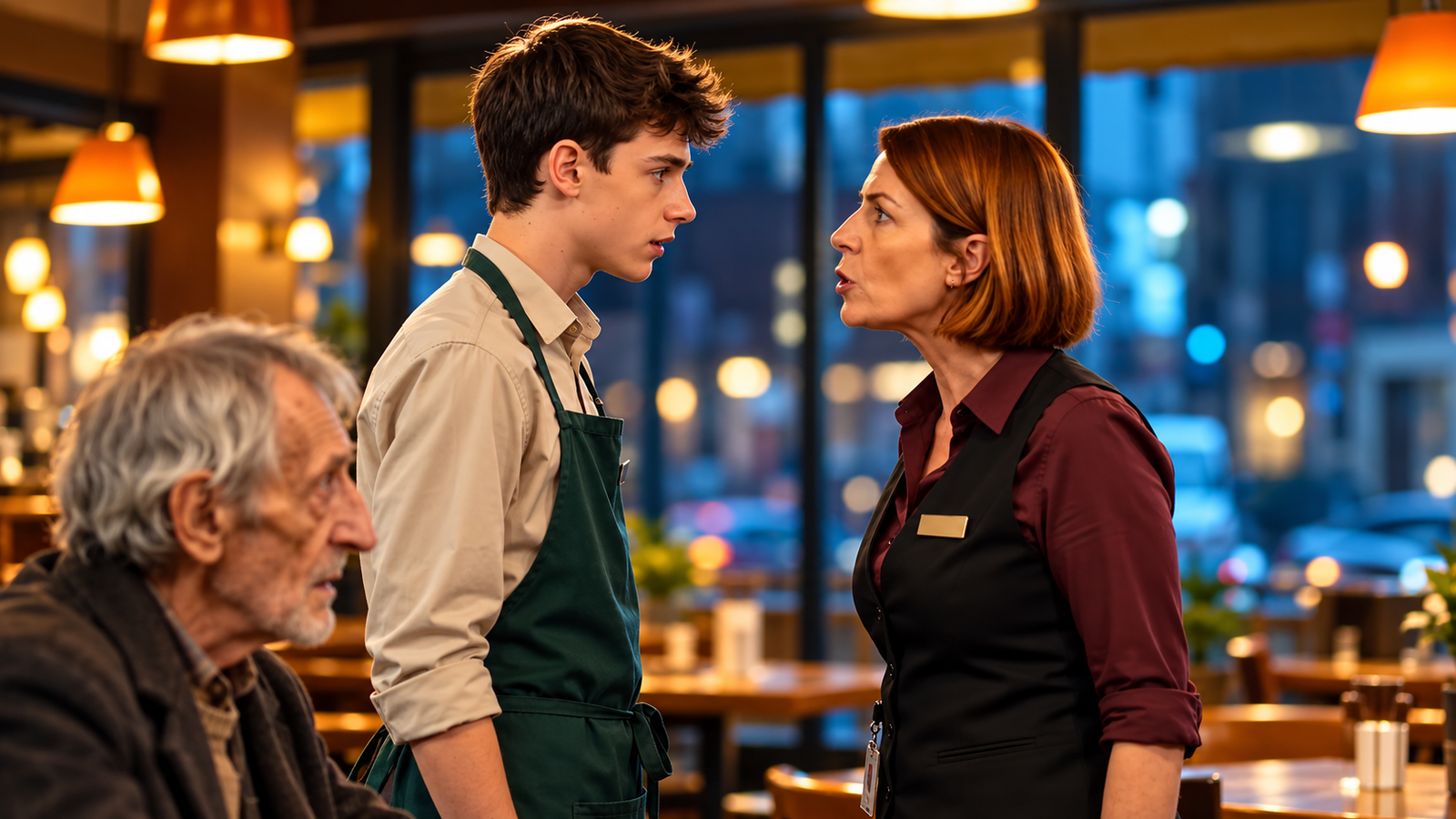
THE MAN AT THE TABLE BY THE WINDOW
PART 1 — THE ONE NO ONE NOTICED
At 7:27 p.m., the small restaurant was almost full.
Outside, a fine rain slid down the windows, stretching car headlights into long trails of light. Inside, hanging lamps cast a warm glow over the small wooden tables. The damp tiles near the entrance still shone with the marks left by customers’ shoes.
You could hear cutlery against plates, the coffee machine, low conversations, and the steady sound of cars on the nearby road.
It was a simple place.
Not the kind of restaurant people visited to be seen.
It served honest food, hot meals, strong coffee, and homemade desserts.
Léo Martin had been working there for almost eight months.
Nineteen years old.
A still-young face, brown hair that was always slightly messy, an olive-green apron, and a beige shirt he ironed himself every Sunday evening.
Léo did not particularly enjoy being a waiter.
But he did enjoy having a paycheck.
His mother worked at a pharmacy twenty kilometers away. His father had left the family several years earlier. Léo had started studying automotive mechanics, but he had been forced to stop because he could no longer afford the training.
The restaurant was not a dream.
It was a necessity.
And necessities often come with a uniform.
That evening, Léo was carrying a small tray with two coffees when he noticed the man sitting by the window.
He had been there for perhaps fifteen minutes.
Alone.
Very thin.
An old dark wool coat that was too large for his shoulders.
White hair, slightly disheveled.
His hands resting around a worn leather wallet.
Léo slowed down.
The man opened the wallet.
Inside were a few coins.
One small, crumpled banknote.
Not enough.
Even from a distance, Léo understood.
The man closed the wallet almost immediately, as though embarrassed that someone might have seen.
Léo continued to the next table, set down the coffees, then returned toward the counter.
Claire Bernard saw him stop.
Claire managed the evening shift.
Forty-eight years old.
Efficient.
Sharp sometimes.
Not mean, according to her.
Just realistic.
“Léo, table twelve has been waiting for five minutes.”
“I’m going.”
But Léo was still looking at the man by the window.
Claire followed his gaze.
“What?”
“Nothing.”
He picked up a jug of water.
Claire frowned.
“Did he order?”
“Not yet.”
“Then wait until he orders.”
Léo did not answer.
He picked up a clean glass.
Then crossed the room.
The man looked up when Léo placed the glass in front of him.
“Here you go.”
The man looked at the glass.
Then at Léo.
“I didn’t order anything.”
“It’s just water.”
A silence.
Then the man murmured:
“Thank you.”
His voice was weak.
But clear.
Léo noticed that his hands trembled slightly when he picked up the glass.
“Are you feeling all right, sir?”
“Yes.”
The answer came too quickly.
Léo remained standing.
“Are you sure?”
The man gave a tired half-smile.
“You ask a lot of questions.”
“I know.”
“Is that a flaw?”
“According to my manager, yes.”
This time, the old man genuinely smiled.
Léo looked at the closed wallet.
He hesitated.
Then asked:
“Are you waiting for someone?”
The man looked at the rain behind the window.
“Maybe.”
Another strange answer.
Léo was about to ask what he wanted to eat when a voice came from behind him.
“Léo.”
Claire.
She approached.
Her eyes moved from the young employee to the man.
“Get back to work.”
Léo turned toward her.
“He doesn’t have enough money to pay.”
The man’s expression changed slightly.
Not anger.
More like quiet embarrassment.
Léo immediately regretted saying it so bluntly.
Claire folded her arms.
“That’s not our problem.”
“He looks weak.”
“Then he can order something he can afford.”
Léo lowered his voice.
“Claire…”
“No.”
She looked at the man.
“Sir, if you’d like to order, we have dishes starting at twelve euros.”
The man did not answer.
Claire turned toward Léo.
“Table twelve. Now.”
Léo stayed where he was.
It was not rebellion.
Not really.
It was that unpleasant feeling he had known since childhood.
The feeling you get when you see something wrong and try to convince yourself that it is not your responsibility to do anything about it.
His grandfather had taught him something different.
When Léo was eight, they had seen a man fall on a sidewalk.
Everyone else kept walking.
His grandfather stopped.
Léo had asked him why.
He could still remember the answer.
“Because if everyone waits for someone else to do something, then nobody does anything.”
Claire repeated:
“Get back to work.”
Léo looked at Henri.
He did not even know his name yet.
He saw the man’s fingers trembling around the glass.
“I can’t leave him like this.”
Claire stiffened.
“Léo.”
He looked up.
“I’ll pay for a meal for him.”
“No.”
“With my own money.”
“That’s not the point.”
“Then what is the point?”
Claire spoke more quietly.
“You’re at work.”
“I know.”
“Then work.”
Léo breathed slowly.
“I can’t pretend I didn’t see him.”
Claire stared at him.
A few customers had started listening.
The restaurant grew quieter.
Claire hated losing control.
She stepped toward Léo.
“Get back to work.”
Léo did not move.
“I can’t leave him like this.”
Claire clenched her jaw.
Then said:
“Then you’re fired.”
Silence.
Real silence.
Even the coffee machine suddenly seemed too loud.
Léo froze.
He had thought Claire might threaten him.
Not actually go through with it.
His paycheck.
The rent his mother could not afford alone.
The studies he hoped to resume.
All of it disappeared in a single sentence.
“Are you serious?”
“Yes.”
Léo felt his throat tighten.
He could have apologized.
He could have gone back to the counter.
He might have saved his job.
But something stopped him.
He looked at Henri.
The old man was watching him.
Silently.
Then Henri set down the glass.
Very gently.
He slipped a hand inside his coat.
Claire and Léo watched.
Henri pulled out a black smartphone.
A modern device, almost strangely out of place in the hands of a man whose wallet held only a few coins.
His fingers stopped trembling.
Completely.
He unlocked the phone.
Made a call.
The change was immediate.
His posture still looked frail.
His face was still tired.
But his voice was no longer that of a lost old man.
It became calm.
Clear.
Authoritative.
“This is Henri Delacroix.”
Léo stared at him.
Claire did too.
Henri waited.
Then said:
“Tell them I’ve made my decision.”
A pause.
“Yes. Tonight.”
He hung up.
No one spoke.
Finally, Claire asked:
“Who are you?”
Henri placed the phone on the table in front of him.
“For the moment, simply a man who needed a glass of water.”
Léo did not know what to say.
A few seconds later, a black sedan stopped outside the restaurant.
Then a second.
Figures stepped out beneath umbrellas.
Dark suits.
Long coats.
A man in his fifties entered first.
He scanned the room.
Then saw Henri.
His expression changed immediately.
He approached.
“Mr. Delacroix.”
Henri raised one hand slightly.
“Not here, Antoine.”
The man stopped.
Looked at Léo.
Then at Claire.
“Of course.”
Léo felt his heart speed up.
Claire turned very pale.
Henri picked up his glass of water.
Then looked at Léo.
“You lost your job because of me.”
Léo gave a nervous laugh.
“Apparently.”
Henri slowly nodded.
“Then you deserve to know why these people were looking for me.”
He turned toward Antoine.
“The meeting?”
“They’re still waiting for your decision.”
Henri looked at the rain behind the window.
Then said:
“They can wait another ten minutes.”
And Léo suddenly understood that the man everyone had taken for a penniless old customer might never have needed saving at all.
Maybe he had come to see who would stop.
---
Ten minutes later, the private room above the restaurant had been opened.
Léo had not even known it existed.
The owner of the building rarely used it for business meetings.
That night, eight people were waiting inside.
Lawyers.
Financiers.
Senior executives.
Claire stayed downstairs.
Léo went up with Henri.
“Why me?” he asked on the staircase.
Henri gave a faint smile.
“Because you’ve already paid the price of being here.”
The door opened.
Every head turned toward Henri.
One man stood up immediately.
“Mr. Delacroix.”
Henri took a seat at the head of the table.
Léo remained near the door.
On the central screen was a photograph of a restaurant chain.
Around fifty locations.
The same brand.
The same logo.
Léo recognized his own restaurant.
He looked at Henri.
Then at the screen.
Then back at Henri.
“You…”
Henri looked up.
“Yes.”
Léo fell silent.
Henri Delacroix was the founder of Delacroix Restauration.
The man whose company indirectly owned the restaurant where Léo had just been fired.
And the people around that table were waiting for him to decide whether he would sell the family business to a major foreign investment fund.
Henri placed both hands on the table.
“I’ve made my decision.”
Every face tightened.
“We are not selling.”
The room erupted.
PART 2 — THE NAME BEHIND THE DOOR
For nearly twenty minutes, Léo understood almost nothing of the discussion.
Words followed one another.
Profitability.
Margins.
Franchising.
Liquidity.
Expansion.
Debt.
Restructuring.
Henri listened.
Calmly.
A man in a gray suit said:
“Henri, the offer is exceptional.”
“I know.”
“One hundred and eighty million euros.”
Léo blinked.
He looked at Henri.
The old man seemed perfectly indifferent.
“A large sum of money is not always the same thing as a good decision,” he replied.
A woman seated on the right spoke up.
“Growth is slowing.”
“Then let’s improve how the business operates.”
“The group needs capital.”
“We’ll find it.”
“Henri, you’re seventy-six years old.”
A heavy silence followed that sentence.
Léo saw something pass through the old man’s eyes.
Fatigue.
Then Henri said:
“Exactly.”
No one answered.
He looked at the screen.
“I spent forty years building this company.”
He paused.
“And today, before signing away its future, I decided to visit one of our restaurants without telling anyone.”
The executives exchanged looks.
Henri continued.
“No assistant. No visible driver. No reservation.”
He looked at Léo.
“I wanted to see what remained of the company when my name disappeared.”
The room fell completely silent.
Henri turned toward Antoine.
“How many people recognized me?”
“No one, sir.”
“Exactly.”
Henri looked around the table.
“And that was the point.”
Léo understood.
The nearly empty wallet.
The old coat.
The absence of an escort.
Had all of it been deliberate?
Not entirely.
Henri really did look exhausted.
But perhaps he had wanted to be invisible.
Henri continued.
“I watched the customers.”
His voice hardened.
“I watched the employees.”
Then his gaze settled on Léo.
“And I saw a nineteen-year-old boy risk his paycheck for someone he believed was unimportant.”
Léo lowered his eyes.
Henri went on.
“Then I watched a manager fire him because he showed humanity.”
A man at the far end of the table frowned.
“Henri, it was only one incident.”
Henri turned his head.
“No.”
The word landed sharply.
“Sometimes one isolated incident reveals an entire system.”
No one dared interrupt him.
“If our employees believe helping someone is a productivity failure, then we have a bigger problem than our margins.”
Léo looked up.
Henri was no longer mysterious.
He was dangerous in a different way now.
Calm.
Precise.
Impossible to impress.
A woman asked:
“You want to cancel the sale because of this?”
Henri shook his head.
“No.”
Then he added:
“But it reminded me why I wanted to refuse in the first place.”
Silence.
Henri looked at Léo.
“Do you know how this company started?”
“No.”
Henri smiled.
“With six tables.”
He looked around him.
“A little bistro in Lyon.”
His voice changed slightly.
Softer.
“I was twenty-eight.”
Léo listened.
“My wife made the desserts. I did the cooking.”
A brief smile.
“Very badly, at first.”
A few people laughed.
“One evening, a man came in to eat.”
Henri was looking into a memory now.
“He didn’t have enough money.”
Léo froze.
Henri continued.
“I was going to ask him to leave.”
A pause.
“My wife served him a bowl of soup.”
He smiled.
“And she told me, ‘If a restaurant doesn’t know how to feed someone who is hungry, then it’s nothing more than a business with tables.’”
No one spoke.
Henri looked at the screen.
“I forgot that sentence for a few years.”
He sighed.
“Then for a few decades.”
Léo felt something tighten in his chest.
Henri straightened.
“I don’t want to sell to people who will turn every employee into a number and every customer into an average ticket value.”
The man in the gray suit replied:
“That’s emotional.”
Henri nodded.
“Yes.”
The man looked surprised.
“And?”
Henri stared at him.
“All important decisions are emotional. The difference is whether the emotion serves fear or values.”
Silence.
Then Henri said:
“The sale is rejected.”
This time, no one argued.
---
After the meeting, Henri asked Léo to stay.
The room emptied.
Antoine closed the door.
Henri drank some water.
His hands began trembling again.
Léo noticed.
“Are you really all right?”
Henri smiled.
“You’re persistent.”
“Yes.”
“No.”
Léo waited.
Henri looked at his hands.
“Early-stage Parkinson’s.”
Léo fell silent.
“And something else.”
“What?”
Henri looked up.
“Cancer.”
Léo remained still.
“For how long?”
“A little over a year.”
“Are you being treated?”
“Yes.”
Henri shrugged.
“With modest results.”
Léo did not know what to say.
Henri smiled.
“That’s why my partners want to sell.”
“And your family?”
The smile disappeared.
“It’s complicated.”
Henri looked at the empty table.
“My son wants the sale.”
“Why?”
“Because he’s afraid.”
“Of what?”
Henri answered simply:
“Of losing me.”
That answer surprised Léo.
Henri continued.
“When people feel death getting closer, they sometimes try to secure everything they can. Money. Assets. Decisions.”
He looked at Léo.
“As though control could prevent grief.”
Léo thought of his absent father.
Of his mother.
Of how little people truly controlled.
Henri continued.
“You lost your job tonight.”
Léo gave a humorless smile.
“Yes.”
“Do you still want it?”
“I need it.”
Henri nodded.
“That’s not the same thing.”
Léo stiffened.
Henri raised a hand.
“I’m not judging you.”
He thought for a moment.
“But I’d like to offer you something else.”
Léo became wary.
“What?”
“Work with me.”
Léo almost laughed.
“No.”
Henri smiled.
“You refuse quickly.”
“I’m a waiter.”
“Dining-room assistant.”
“Even better.”
Henri laughed.
“Are you studying?”
“I stopped.”
“Why?”
Léo hesitated.
“Money.”
Henri slowly nodded.
“What were you studying?”
“Automotive mechanics.”
Henri looked interested.
“And you liked it?”
“Yes.”
“Then why stay in a restaurant?”
Léo looked at his hands.
“Because rent is due every month.”
Henri did not answer immediately.
Then he said:
“I don’t want to pull you out of your life with a check.”
Léo looked up.
“Good.”
“I hate charity that humiliates people.”
Henri placed his smartphone on the table.
“I’m offering you an internal apprenticeship contract.”
Léo frowned.
“In what?”
“Operations. Logistics. Maintenance.”
Léo remained silent.
Henri continued.
“Our restaurants have kitchens, equipment, ventilation systems, delivery vehicles.”
He smiled.
“And a lot of problems.”
“You want me to repair your refrigerators?”
Henri laughed.
“Maybe one day.”
Then he became serious.
“Mostly, I want someone who sees what everyone else has stopped noticing.”
Léo folded his arms.
“You don’t know me.”
“Exactly.”
Henri nodded.
“That’s why I’m not offering you a director’s job.”
Léo smiled slightly.
“Thankfully.”
“I’m offering you the chance to restart your studies through a work-study program.”
Léo said nothing.
Henri continued.
“The group will pay the tuition. You’ll work in several departments. You’ll earn your salary.”
“Why me?”
Henri looked directly at him.
“Because tonight, you did something that cost you something.”
Léo frowned.
Henri continued.
“A lot of people are generous when generosity costs them nothing.”
Silence.
“You chose someone else when doing so could cost you your job.”
Léo looked toward the door.
“It still feels stupid.”
Henri smiled.
“Good decisions sometimes look like bad decisions at the wrong moment.”
---
Downstairs, Claire was waiting.
Alone.
The service was almost over.
She was still wearing her blazer.
Her face was closed off.
Léo came down.
She turned toward him.
“So?”
“So what?”
“Who is he?”
Léo looked at her.
Then answered:
“The founder of the group.”
Claire turned white.
She leaned slightly against the counter.
“No.”
“Yes.”
She closed her eyes.
“My God.”
Léo said nothing.
Claire murmured:
“I’m dead.”
“Probably not.”
She stared at him.
“You think this is funny?”
“A little.”
Claire ran a hand over her face.
“He’s going to fire me.”
Léo thought about the way Henri had spoken.
“I don’t think so.”
“Why?”
“Because he doesn’t seem to like easy solutions.”
Claire looked at him.
For a long time.
Then she said:
“I was wrong.”
Léo remained silent.
She continued.
“I shouldn’t have fired you.”
Léo shrugged.
“No.”
Claire exhaled.
“You could make this easier for me.”
“You fired me in front of everyone.”
“All right.”
She almost smiled.
Then her expression became serious again.
“I’m sorry.”
This time, Léo could see that she meant it.
He nodded.
“Thank you.”
She looked at the empty dining room.
“They ask us to run the service with fewer people every year.”
Léo listened.
“Every minute is measured. Every table. Every delay. Every customer review.”
She shook her head.
“I think I eventually started seeing people as obstacles to the schedule.”
Léo thought of Henri.
“That can change.”
Claire gave a bitter laugh.
“If I keep my job.”
A voice came from behind them.
“You will.”
They turned.
Henri was slowly coming down the stairs with Antoine.
Claire stiffened.
Henri stopped.
“Madame Bernard.”
“Mr. Delacroix.”
She struggled to speak.
“I’m…”
Henri raised a hand.
“You made a bad decision.”
Claire lowered her eyes.
“Yes.”
“Why?”
Claire hesitated.
Then she gave him the same answer she had given Léo.
Reduced staffing.
Targets.
Pressure.
Productivity.
Henri listened without interrupting.
Then said:
“Very well.”
Claire looked up.
“Very well?”
“You didn’t hide behind an excuse.”
He thought.
“You’ll be suspended from your supervisory duties for one week.”
Claire nodded.
“And after that?”
Henri replied:
“After that, you’ll take part in a complete review of our procedures.”
She looked surprised.
“Me?”
“You understand the problems on the ground better than most of my executives.”
Henri looked at Léo.
“And so does he.”
Léo shook his head.
“I didn’t ask for anything.”
Henri smiled.
“You’ll learn that important responsibilities often arrive that way.”
Then he left.
Léo watched him disappear into the rain.
He did not know it yet.
But that night was going to change far more than one job.
It was going to crack open an entire company.
And behind that crack was something even Henri did not know yet.
PART 3 — WHAT THE GROUP WAS HIDING
Three months later, Léo had resumed his studies.
The change had been abrupt.
In the mornings, he attended technical classes.
In the afternoons, he worked in the Delacroix Group’s maintenance departments.
He learned about cold-storage rooms, electrical circuits, ventilation systems, cleaning contracts, and logistics schedules.
He liked it.
Not all of it.
Meetings bored him.
Excel spreadsheets even more.
But understanding how a restaurant actually worked fascinated him.
Claire was still there.
And she had changed too.
Not miraculously.
Not completely.
She was still demanding.
Sometimes sharp.
But now she asked one question before punishing anyone.
Why?
And that single question changed a lot of things.
Henri, meanwhile, came in less and less often.
His treatment exhausted him.
Still, he called Léo every Friday.